A fork does several jobs
A telescopic fork guides the front wheel, supports load, permits suspension movement and transmits steering and braking forces. Its sliding bushes and seals must accommodate movement while its tubes resist bending. The requirements overlap: a structure that is strong enough for braking still needs low-friction, well-aligned sliding surfaces to respond to small inputs.
Conventional and upside-down forks place their larger and smaller tube sections differently. That changes structural packaging and mass distribution, but the label alone does not determine ride quality. Tube dimensions, bush spacing, clamp design, damping architecture, wheel assembly and maintenance all influence the result.
Fork legs can divide functions. One may carry more of a particular spring or damping role while the axle and clamps connect both legs structurally. Never assume that two externally similar caps require identical adjustments or contain identical internals.
Internal architecture shapes oil control
A damper-rod fork and a cartridge fork provide different ways to control oil flow. Cartridge systems place a piston and valve arrangement within a dedicated assembly. Open and closed cartridge designs manage their oil and compensation arrangements differently, with further variations inside each category.
Fork oil also interacts with the trapped air volume. As a fork compresses, the air space can provide increasingly significant additional support. Oil quantity or air-gap changes therefore affect more than lubrication. Incorrect filling can alter usable travel or create dangerous pressure conditions, so generic oil-height recommendations are inappropriate.
Manufacturer viscosity labels do not guarantee interchangeable behaviour across different oil brands. The specified fluid, fill procedure and bleeding method belong to the exact component. A suspension workshop may use temperature-aware viscosity data and component-specific experience; a bottle's broad grade label is not a complete engineering specification.
A reservoir manages displaced volume
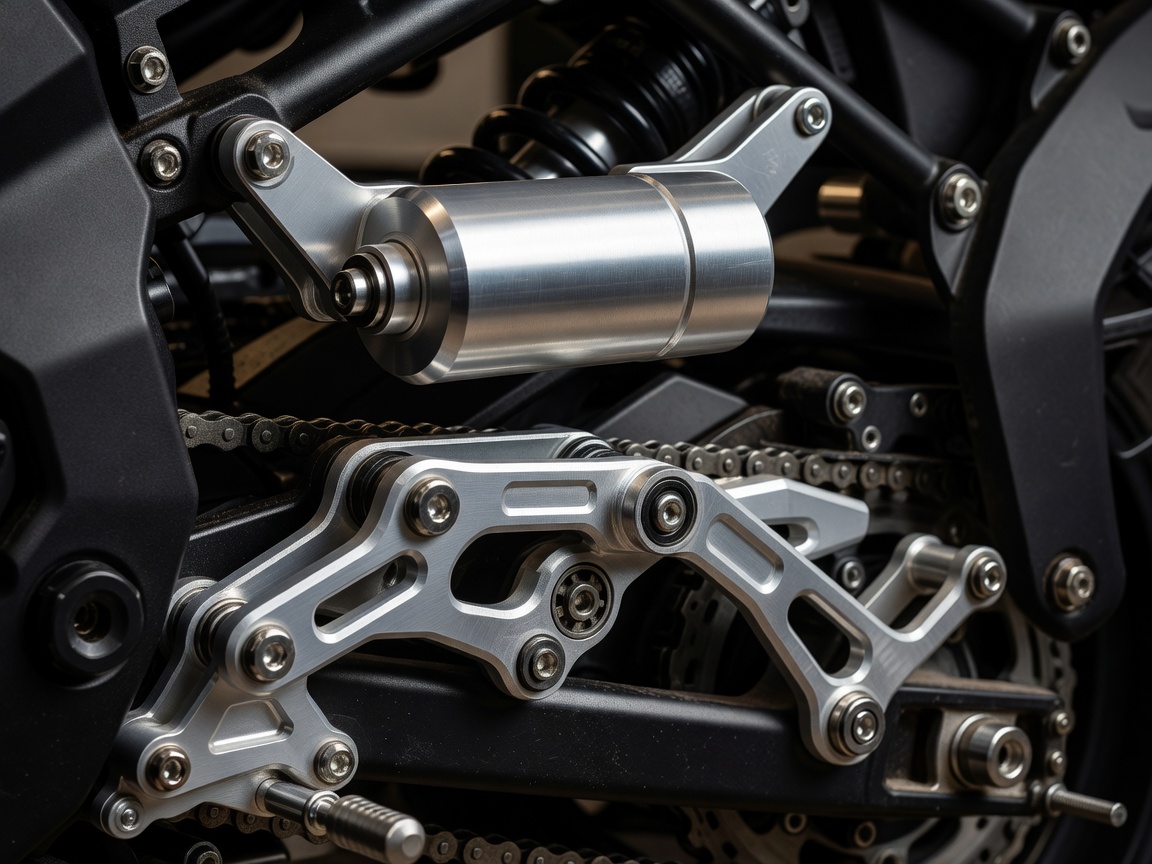
A shock shaft entering its body occupies volume. The assembly needs a way to accommodate that displacement while maintaining suitable hydraulic conditions. A gas-separated reservoir can use a floating piston or bladder to separate oil from the gas volume. Some reservoirs are attached directly; others are connected remotely.
Reservoir size, gas pressure, oil volume and valve layout all contribute to operation. A visible external reservoir does not, by itself, prove that a shock will perform better for a particular rider or task. Condition, specification, installation and thermal demands still matter.
Pressurised shocks require specialist handling. Do not loosen a reservoir, release gas, open a body or dismantle a spring assembly to investigate a symptom. A visually small component can retain substantial pressure or stored energy.
Linkages transform motion and force
The rear wheel travels around the swingarm pivot while the shock follows its own mounting geometry. A linkage changes how much the shock moves for a given amount of wheel movement, and that relationship may vary through travel. This is the basis of many rising-rate rear suspension arrangements.
Define the ratio before comparing numbers. If motion ratio means shock travel divided by wheel travel, a simplified constant-ratio relationship gives wheel rate approximately equal to spring rate multiplied by the square of that ratio. Real changing-ratio systems introduce additional geometry effects, so that expression is a teaching model rather than a complete design calculation.
Leverage changes both movement and force. Pivot friction adds a separate influence.
Bearings and seals are central to that mechanism. Corrosion, play or binding changes how freely the assembly moves. A worn linkage may create inconsistent response even when the shock itself has been serviced. Lubrication, fastener tightening and bearing replacement must follow the relevant workshop procedure.
Alternative paths, different compromises
BMW Telelever and Duolever separate some steering, guidance and suspension functions differently from conventional telescopic forks. Hub-centre steering systems, including Bimota Tesi applications, use another arrangement of links and pivots. These architectures change force paths and geometry behaviour; they do not remove the need for tyres, bearings, suitable damping or careful maintenance.
Unsprung mass is also a system property. Wheels, tyres, brakes and portions of moving suspension components participate in wheel motion. Lower mass can help in some response conditions, but stiffness, durability, braking requirements and packaging constrain design choices.
For deeper mechanical context, Tony Foale's Motorcycle Handling and Chassis Design and Vittore Cossalter's Motorcycle Dynamics are established references. Pair general theory with the exact manufacturer's workshop information. Hardware identification should precede any conclusion about service intervals, adjustment functions or replacement compatibility.