Start with the safety decision
A sudden handling change deserves a different response from a long-standing preference about comfort. Fluid leakage, loose components, impact damage, tyre damage, unusual mechanical noises or a steering disturbance can indicate a fault. Stop in a safe place and arrange qualified inspection or recovery when continued use may be unsafe.
Do not try to reproduce wobble, weave or loss of grip to gather more evidence. Public-road experiments cannot isolate variables safely, and a fault may become worse without warning. An online explanation cannot establish whether a motorcycle is roadworthy.
A useful diagnostic framework therefore begins with a boundary: observations can inform an inspection, but they cannot replace it. The absence of an obvious leak or visible broken part is not proof that the machine is mechanically sound.
Describe the event without naming a cure
Record the motorcycle model and year, fitted suspension, tyre make and model, load and recent maintenance. Note whether the behaviour was present before a tyre replacement, luggage change, impact or service. These details help separate a change in the machine from a change in expectations.
Describe the input: a single sharp edge, a long undulation, repeated surface irregularities, braking or acceleration. Note whether the sensation seems to originate at the front, rear, seat, handlebar or whole chassis. Record only what was already observed in normal safe use; do not create a testing task to fill every field.
Distinguish an observation from an interpretation. “The rear felt lower after several bumps” is more useful than “the rebound is wrong”. The first gives a specialist evidence to consider. The second narrows the investigation before the underlying facts have been checked.
Keep multiple causes open
A tyre is part of the suspension system in the broad mechanical sense. Inflation, construction, wear, damage and temperature affect its compliance and response. Use the motorcycle and tyre manufacturer's approved guidance for the actual load and application. Do not adopt track pressures or another rider's settings as a road baseline.
Michelin, Pirelli, Bridgestone, Dunlop and Metzeler offer tyres with different constructions and intended uses. Even approved fitments can feel different. A change in feedback after fitting tyres does not automatically mean the damper needs adjustment.
| Observation | Possible contributors | Useful context for inspection |
|---|---|---|
| Sharp impacts feel harsh | Tyre condition, friction, damping, limited travel | Surface type, load, recent service, visible damage |
| Repeated bouncing | Damping condition, spring/load mismatch, tyre or chassis effects | Whether it follows one input or repeated inputs |
| Rear appears to settle over repeated bumps | Recovery restriction, load, travel use, geometry | Existing observations and component specification |
| New steering instability | Tyres, bearings, alignment, loading, damage or other faults | Stop riding if unsafe; arrange professional assessment |
Inspect the baseline before tuning
A qualified inspection may include tyres and wheels, steering-head bearings, wheel bearings, fork alignment, shock mountings and linkage movement. The exact work depends on the motorcycle and complaint. A steering damper does not repair worn bearings, and additional compression damping cannot release a binding fork.
Service history matters because damping oil, seals, bushes and bearings change with use and environment. A calendar interval and a distance interval are not interchangeable unless the manufacturer says so. Water exposure, contamination and demanding use may introduce additional requirements.
Where measurements are appropriate, use the prescribed method and keep them repeatable. A travel indicator can show a position reached, but it does not explain when that position occurred or what forces produced it. It should not be treated as a standalone verdict about spring rate or damping.
Make records useful, not risky
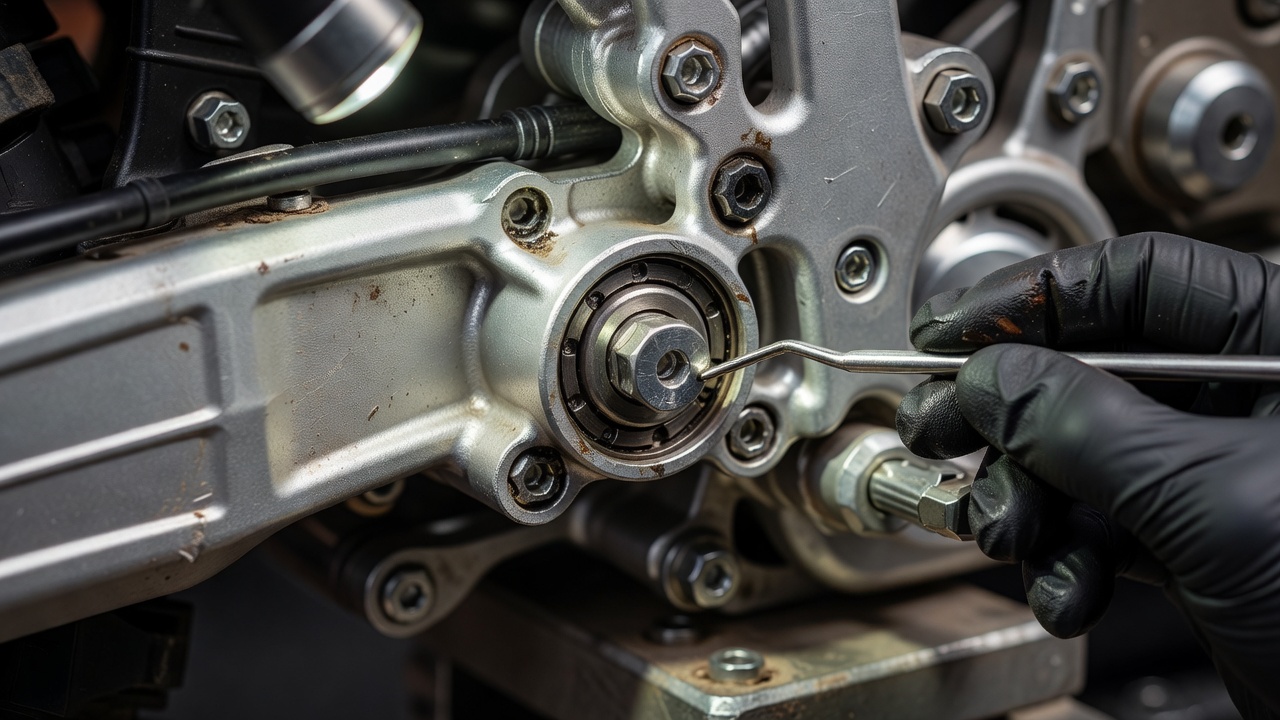
After the motorcycle is confirmed safe, any authorised adjustment should remain within the component manufacturer's instructions. Record the baseline, the intended question and the change. A controlled comparison requires suitable conditions and competence; it is not a reason to exceed road limits or seek the edge of available grip.
Changing multiple settings together obscures cause and effect. Equally, changing one thing at a time does not make an unsafe experiment acceptable. A specialist may need workshop measurements, a damper dynamometer, controlled facilities or simply further mechanical inspection rather than another road ride.
For a workshop enquiry, provide your observations, exact hardware and service history. State what is unknown. Avoid claiming a diagnosis based on a forum phrase, and do not omit warning signs because they do not fit the preferred explanation.